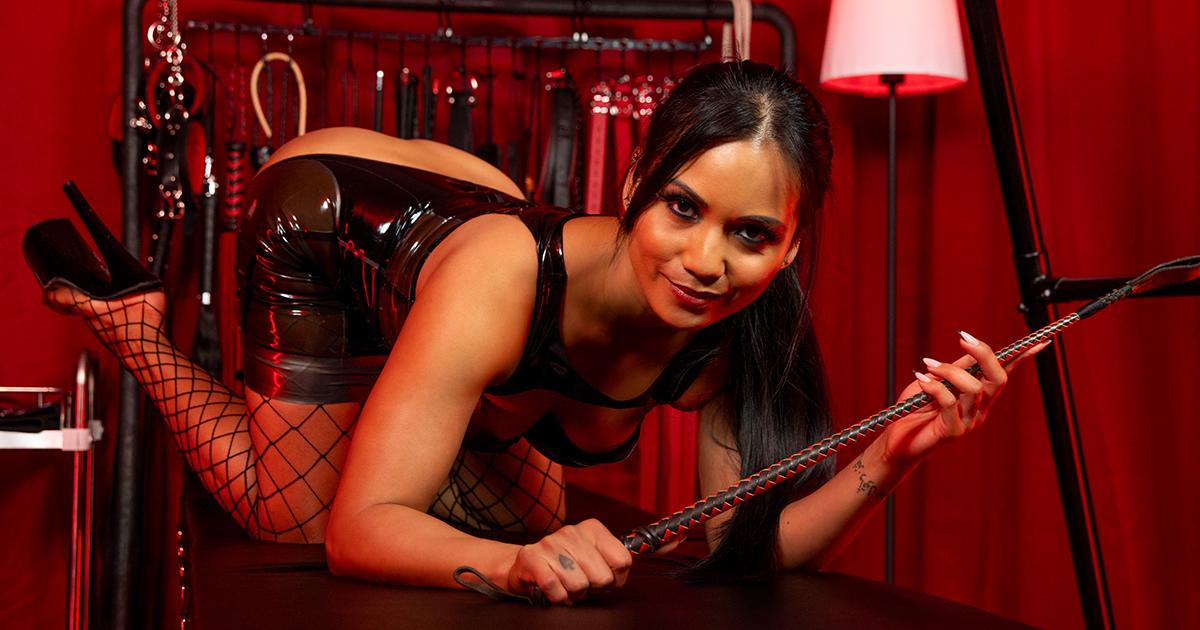
A handheld prop can hold attention before anyone uses it. In this banner, a braided line runs diagonally across the foreground while the performer leans toward the camera. Its length carries the eye from her hand toward the edge of the frame. Nothing needs to strike for the object to become a clear part of the picture.
Braiding gives the prop a visible texture. A narrow line can be easy to lose against a busy wall of equipment, but here it stays separate from the red background. The close viewpoint also lets the viewer see where the performer holds it, which matters more to the photograph than a guess about what she might do next.
Different flexible tools have different forms. A braided whip is not the same visual object as the strands discussed in our guide to flogging in BDSM VR. Keeping those distinctions clear makes it easier to describe what is actually on screen instead of treating every handheld prop as interchangeable.
Her expression and grip give the image its immediate energy. She could hold the prop still, lower it, or move it out of view; a photograph cannot settle that sequence. The open question is part of the composition. The viewer watches the person making the choice.
In a VR scene, distance can make a long prop especially noticeable as it crosses the frame. The still offers a simpler lesson: an object becomes interesting through its placement and the attention the performer gives it, well before any action is shown.